Speaker notes your Zoom call cannot see.
Your notes stay on your screen and out of the screen share. On Zoom, everyone else sees your deck and never your speaker notes. Paste your notes in to use CueCard with any deck, or add the browser extension so notes from Google Slides follow your slides.
- 13K+ downloads
- Free and open source
Thanks for joining — I'll share my screen in a second.
wait for the green dot
You can see my deck now. You cannot see this window.
let that land
These are my speaker notes, sitting on my screen and left out of what Zoom is sending you.
slow down
The clock at the top is counting this section down, so I finish when I said I would.
check the time
And the pink lines are reminders about how to say the next part.
smile, then move on
Right — on to the numbers.
Adjust the speed to your pace. Pink lines are reminders, not words to read aloud.
What you get
Everything Zoom sees is your slide
-
01
Hidden while you share your screen on Zoom
Zoom shows everyone your slides and never your notes.
-
02
Notes that keep up with your slides
Google Slides notes follow the slide you are on. Any other deck, paste your notes in.
-
03
A countdown you can see
Keep a thirty-minute Zoom call to thirty minutes.
-
04
On your phone as well
Filming after the Zoom call? CueCard for iPhone and iPad floats your script over whatever you record in.
The app itself
What it looks like.
Write the script, press play and it scrolls, then set it up the way you read.
-
![CueCard for Mac and Windows with a script open, its [cue] directions in pink and a Set Timer button in the corner.](/assets/desktop-script.webp)
Write the script, with your cues in brackets. -
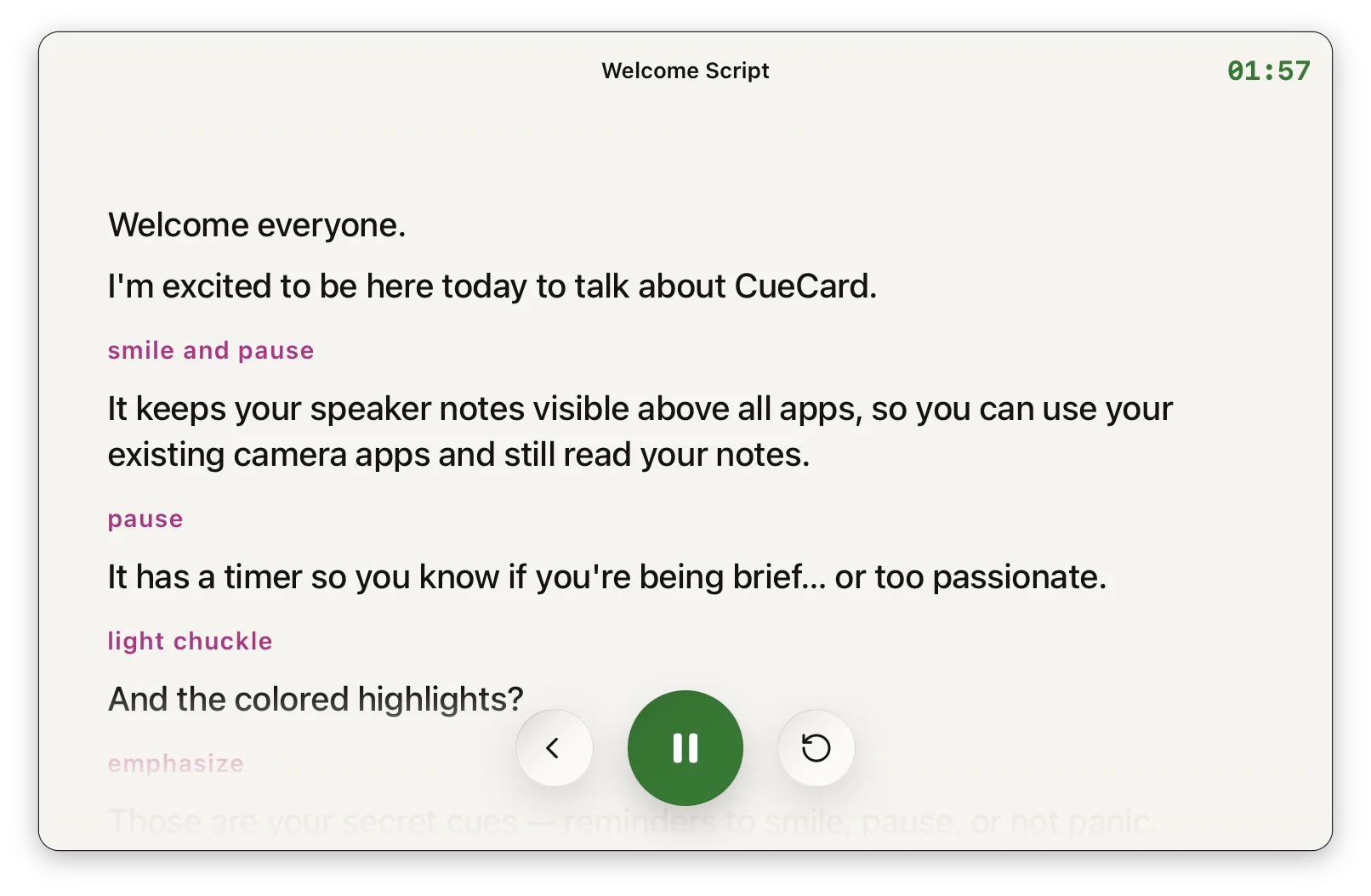
Press play and it scrolls, with the clock running. -
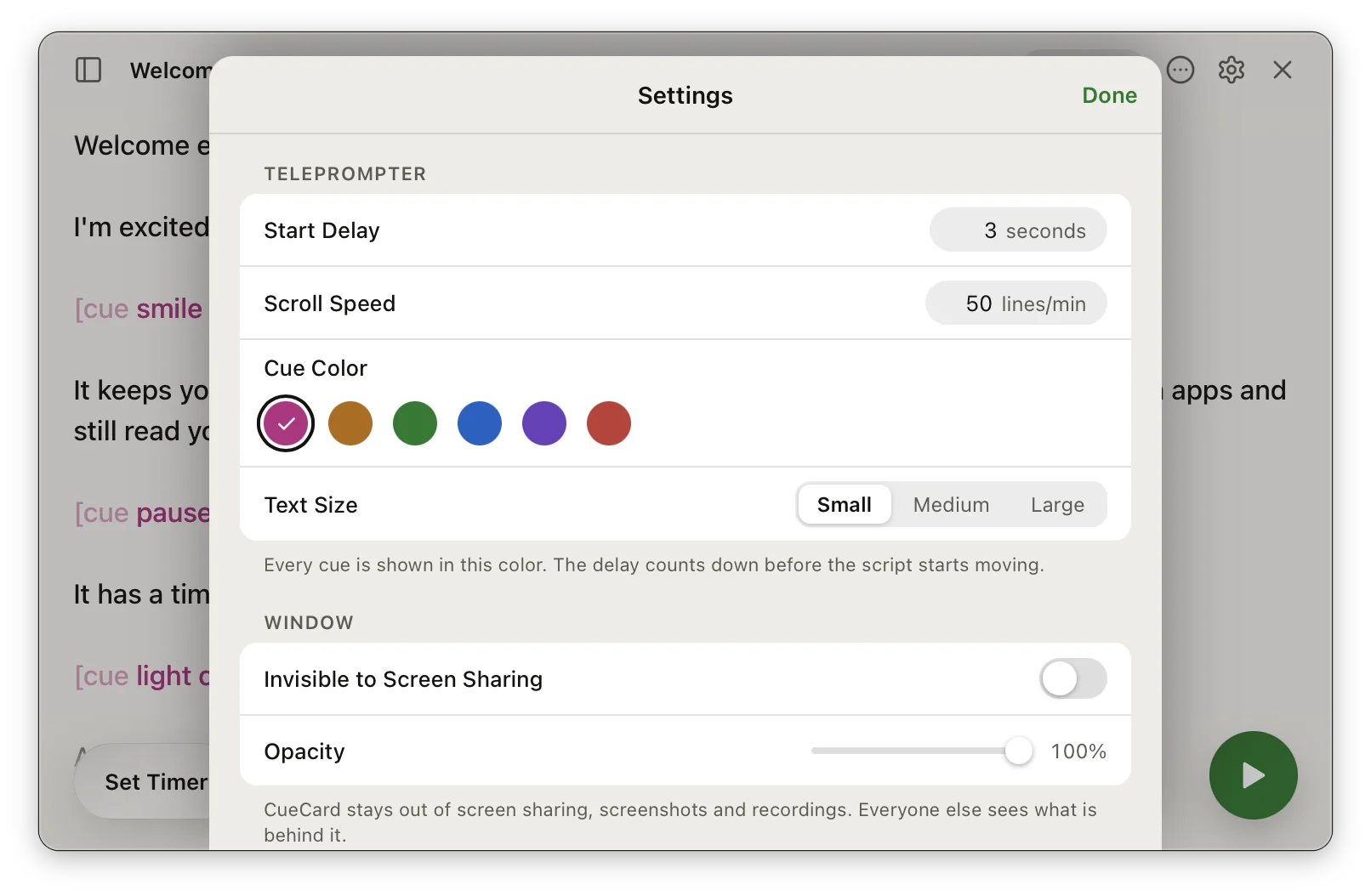
Set the speed, the cue colour and what screen share can see.
On Mac and Windows
See it work
A minute of it, on a shared screen
A short film of the notes staying off the screen everyone else can see. It opens on YouTube.
The script
Write it plainly. Read it like a pro.
Type your script the way you would say it out loud. There is one optional tag to learn: a cue. A cue reminds you how to say the next line, and CueCard shows it in colour so you notice it without reading it out.
What you write
Ordinary text, with [cue] added wherever it helps.
What you see
Your cues show up in the colour you picked while the rest of the script scrolls past in plain text, so your eye catches them and your mouth does not.
Where it earns its place
The Zoom calls people keep it open for
- Client calls on Zoom
- Zoom webinars
- All-hands on Zoom
- Sales demos over Zoom
- Zoom interviews
- Board and investor calls
Made for
Whoever has to hold the room
Also on your phone
Filming a video instead? There is an app for that.
Download
Ready for your next Zoom call?
Download CueCard for Mac or Windows, paste your notes in, and share your screen without sharing them.
Find macOS installers on GitHub Find Windows installers on GitHub
Frequently asked
Questions about CueCard and Zoom
Are speaker notes invisible on Zoom?
Yes. The CueCard window is left out of screen capture by the operating system, so Zoom sends everyone your slides and never your notes, even though the window is right there on your screen. Try one practice share first to see it for yourself.
How do I use speaker notes in Zoom meetings?
Install CueCard for Mac or Windows, paste your notes in or sync them from Google Slides, then start your Zoom call as usual. Your notes sit on your screen where you can read them, and stay out of what you share.
Can I sync Google Slides notes for Zoom presentations?
Yes. Install the CueCard browser extension alongside the app, and the speaker notes for the slide you are on appear in CueCard and change as you move through the deck. Google Slides is optional, though — paste your notes straight in and CueCard works with any deck, or with none at all.
Does the desktop app scroll my script automatically?
Yes. Press play to open the prompter. In Settings, choose Scroll Speed in lines per minute, a Start Delay before scrolling begins, and Small, Medium or Large text. You can pause, go back ten seconds, restart or scroll by hand. Google Slides notes can scroll too.
Can I save, import and export scripts on desktop?
Yes. Choose Save as New from the ••• menu to name a script, then open it again from Scripts in the sidebar. Save updates the current script. Import from File and Export to File let you move scripts as text files, with cues included.
Which operating systems does the desktop app run on?
macOS and Windows. Both builds are on the downloads section and on the GitHub releases page.
Do I need an account to use CueCard?
No. There is nothing to sign up for on either app, and your scripts and settings live on your device. The one exception is Google Slides sync on the desktop app, which asks you to sign in with Google so it can read the notes out of your deck. See the privacy policy for the details.
Is CueCard free?
Yes. CueCard is completely free on mobile and on desktop, and open source. Read the code on GitHub — and a star is always welcome.