Cue cards for public speaking.
A talk at a meetup, a conference slot or a toast at work goes better when you know the next point without having to remember it. Put each on a card, and keep the deck on your phone, your Lock Screen or your wrist.
- 3,600+ downloads
- — GitHub stars
- Free and MIT licensed
Open: the 3 a.m. pager alert.
pause
Point 1: most outages start with a change we made.
Point 2: small changes, shipped often, break less.
Point 3: make rollback the easiest button.
slow down
Close: sleep through the night. Questions?
smile
The pink lines are cues, written for you to read and not to say, and the clock at the top is the timer counting how long you have been talking.
Open: the 3 a.m. pager alert. pause
Swipe the card or tap Next. The pink words are cues, reminders you never say out loud, and the clock counts up from when you started.
What you get
Speaking notes that help, not distract
-
01
The next point, not the whole talk
A few words per card, so you speak rather than read.
-
02
A timer that keeps you in your slot
It warns you before the end and shows when you run over.
-
03
Phone, Lock Screen or wrist
Read from the lectern, a locked phone or your Apple Watch.
-
04
Cues for delivery
Where to pause, slow down or look at the audience.
The app itself
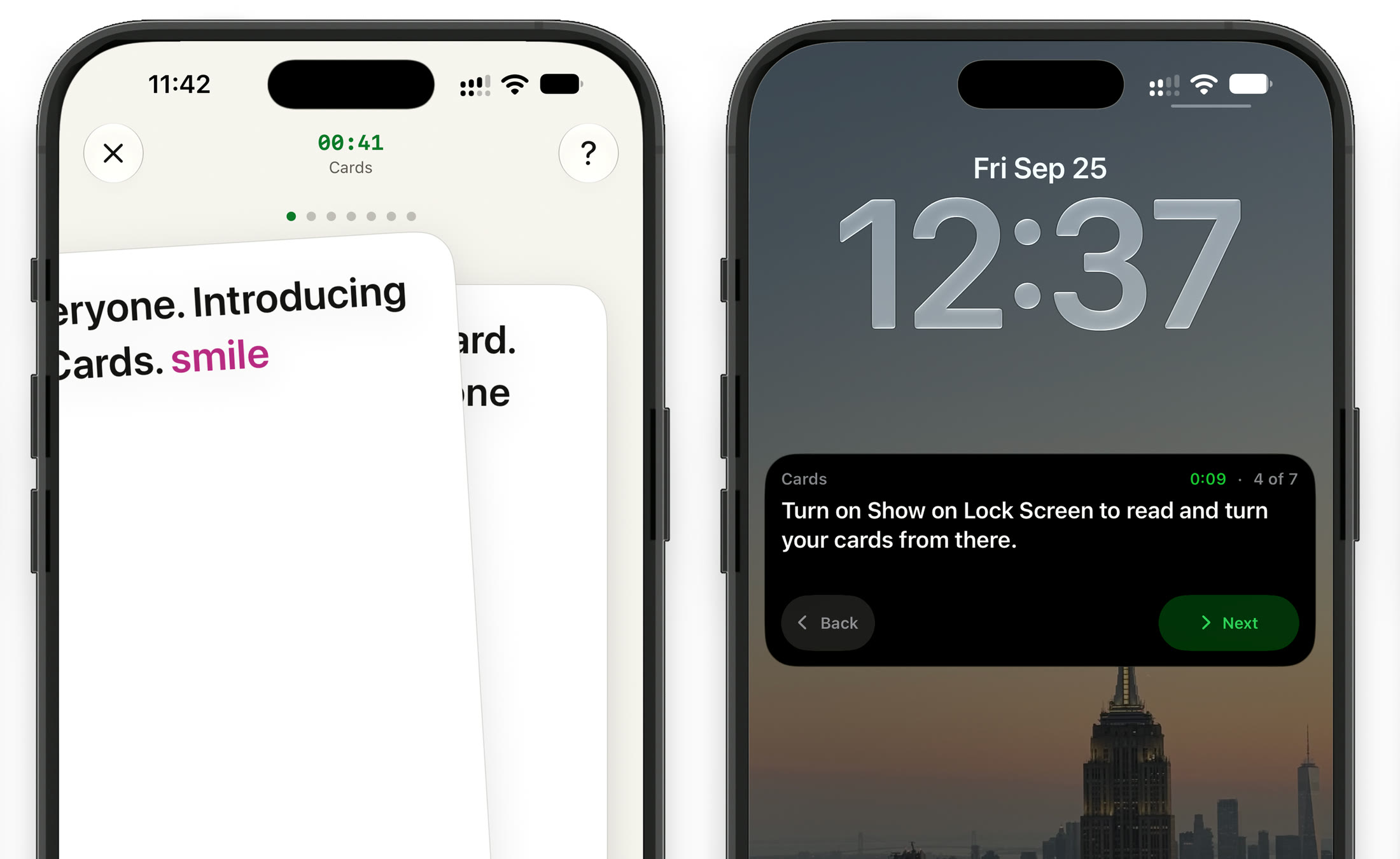
What it looks like.
Swiping to the next card in the app, and the same deck on the Lock Screen with Back and Next.
The rest of CueCard
Need every word instead? There is a teleprompter too.
- Teleprompter Your whole script, scrolling at your pace, full screen or floating over the app you film in. See how it works
- Cards One point at a time. Swipe through in the app, on the Lock Screen or on your watch. See how it works
- Apple Watch A remote for the teleprompter, and your cue cards on your wrist. See how it works
Cue cards for
Whatever it is you have to stand up and say
Get CueCard
On your phone in under a minute
Free, with no account required, no subscription and nothing to cancel.
On your phone, iPad and watch
A teleprompter that floats over the app you film in, and cue cards for when you speak.
Written setup guide
How to give a talk from cue cards
Outline the talk first. Then give each point its own card.
-
01
Switch to Cards
Tap the mode name at the top left of CueCard's editor and choose Cards.
-
02
One section per card
Write your opening line on the first card, one card for each point, and your close on the last. A few words each is enough.
-
03
Add cues where you rush
Type [ or tap Add Cue for reminders like [cue pause] or [cue look up]. They show in color and are never read out.
-
04
Set a timer with a warning
Tap the timer beside Read Cards, set how long you have, and use Warn in Last so the time changes color before you run over.
-
05
Rehearse with Read Cards
Tap Read Cards and run the whole deck out loud, swiping or tapping Next. Cut any card you have to squint at.
-
06
Speak from your Lock Screen or watch
Turn on Show on Lock Screen in Cards Settings to turn cards with the phone locked, or keep the deck on your Apple Watch and leave the phone in your pocket.
A short deck to try
One card per paragraph: type each into its own box in CueCard.
Open: the 3 a.m. pager alert. [cue pause]

Point 1: most outages start with a change we made.

Point 2: small changes, shipped often, break less.

Point 3: make rollback the easiest button. [cue slow down]

Close: sleep through the night. Questions? [cue smile]
Frequently asked
Questions, answered.
Should I use cue cards for a speech?
Cue cards are a good fit when you know your material and want reminders, not a script. If you need every word, as for a video, use the teleprompter instead. CueCard has both.
Can I use cue cards while presenting slides?
Yes. Write a card per slide and turn it when you change slides. If you present from a laptop over a video call, CueCard for Mac and Windows keeps notes out of your screen share, and can follow Google Slides.
Can I turn cards without looking at my phone?
With the Apple Watch app, tap or swipe on the watch and the phone moves with it. On the Lock Screen, tap Back or Next.
Do I need an account to use CueCard?
No. There is nothing to sign up for on either app, and your scripts and settings live on your device. The one exception is Google Slides sync on the desktop app, which asks you to sign in with Google so it can read the notes out of your deck. See the privacy policy for the details.
Is CueCard free?
Yes. CueCard is completely free on mobile and on desktop, and open source under the MIT licence. Read the code on GitHub — and a star is always welcome.
Is CueCard open source?
Yes, MIT licensed, on GitHub. An app that can see your script is one worth being able to read the source of.
Where are my scripts stored?
On your device. Your notes are not uploaded to us. The privacy policy sets out exactly what is and is not kept.
How do I report a bug or ask for a feature?
Open an issue on GitHub, or email support@cuecard.dev. Both are read.